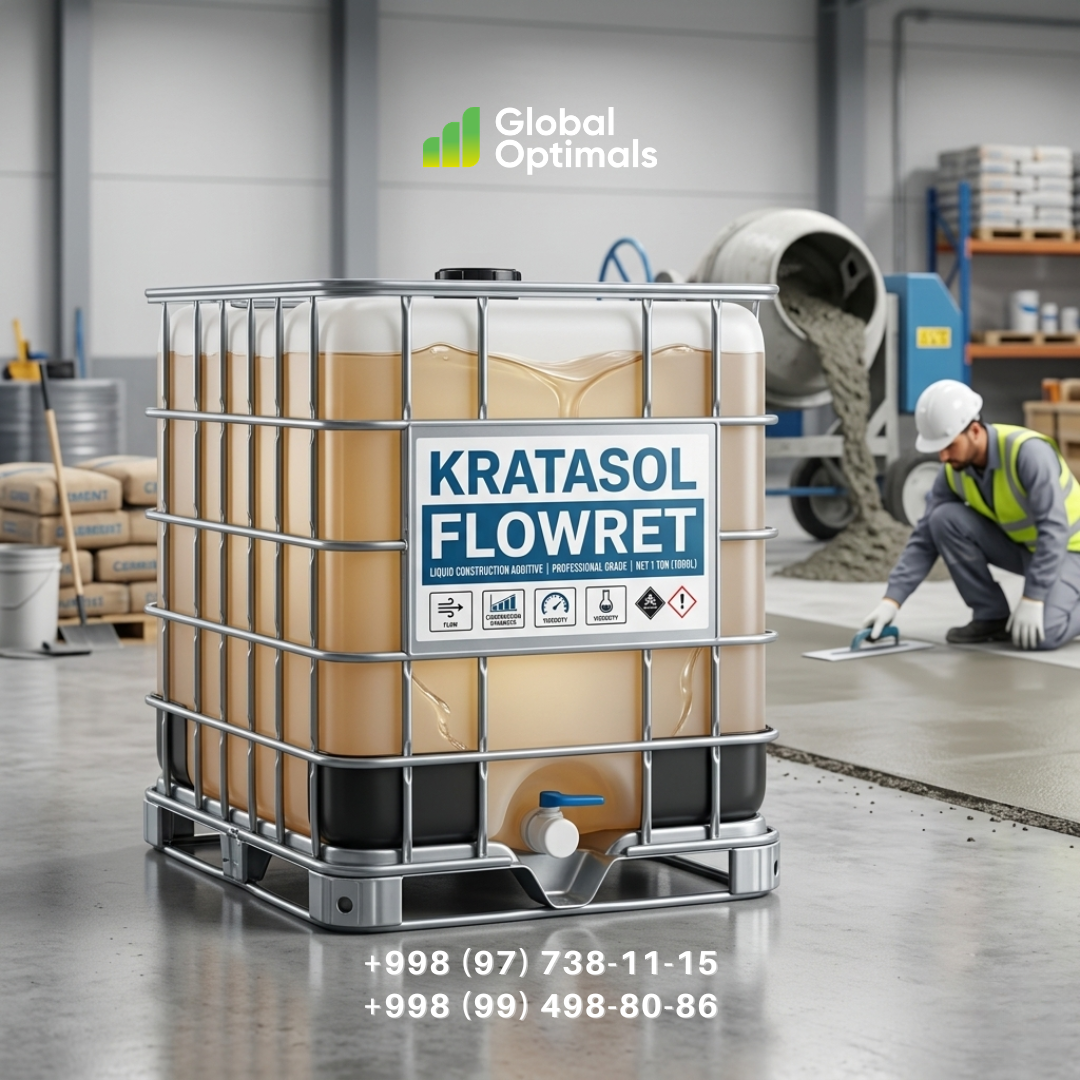
KRATASOL FLOWRET (grade A/B) is a high‑performance superplasticizer designed to enhance concrete mix properties. Active ingredient content ≥99 %, density 1.0 g/cm³, pH 6.5–7.5. The product is based on polymeric carboxylate copolymers that adsorb onto cement particles, forming a thin hydrophobic film which reduces inter‑particle friction and promotes rapid dispersion. This mechanism enables a substantial reduction of the water‑cement ratio while maintaining excellent workability, making the admixture ideal for high‑strength (HPC) and self‑consolidating concrete (SCC) applications. It is used in concrete production, road pavement repair, and structural construction, delivering up to 30 % higher compressive strength and allowing water‑cement ratios as low as 0.35. When combined with supplementary cementitious materials such as silica fume, fly ash, or nano‑titanium dioxide, the superplasticizer synergistically improves density, durability, and resistance to chloride ingress. Compatibility with common accelerators (e.g., calcium sulfate) is confirmed, although dosage should be monitored to avoid premature setting. The KRATA brand guarantees consistent quality, compatibility with CEM I Portland cement, and resistance to alkali‑silica reactions, which is valuable in environments rich in reactive silica. For storage, keep the product in a dry, cool environment (5–30 °C) away from direct sunlight. Packaged in 25 kg containers for easy handling and dosing. Typical dosing ranges from 0.5 % to 1.5 % of cement weight, adjusted according to desired slump and target strength. Full technical documentation (TDS, SDS, COA) is provided, simplifying on‑site certification and quality control.
| Purity | ≥99% |
| Packaging | 25 кг |
| Consistency | жидкая |
| pH value | 6.5–7.5 |
1 ton IBC
Store Kratasol Flowret in a dry, well‑ventilated area protected from direct sunlight and moisture. Recommended storage temperature is between +5 °C and +30 °C; lower temperatures may cause crystallisation, while higher temperatures accelerate product ageing. The typical shelf life is 12 months provided the packaging remains intact. During transport and unloading avoid impacts and mechanical damage to preserve container sealing. Use protective gloves and safety glasses when handling, and prevent skin or eye contact.